
IRCC Translation Requirements: Complete 2026 Guide for Immigration Applicants
What Are the IRCC Translation Requirements in 2026?
Immigration, Refugees and Citizenship Canada (IRCC) requires that all documents not in English or French be accompanied by a certified English or French translation. Whether you are applying for permanent residence, citizenship, a work permit, or family sponsorship, meeting these requirements is essential to avoid delays or outright rejection of your application.
This guide covers everything you need to know about IRCC translation requirements as of 2026, including who can translate your documents, what format is accepted, and the most common mistakes applicants make. The rules themselves — as a checklist, with the IRCC page each one comes from and the date we last checked it — are kept current on our IRCC translation requirements reference page.
Who Can Translate Documents for IRCC?
IRCC does not require translations to be done by a member of a specific professional body. However, the translation must be completed by someone who meets the following criteria:
- The translator must be fluent in both languages (the source language and English or French)
- The translator cannot be the applicant or an immediate family member of the applicant
- The translator must provide a signed certification statement
What Must the Certification Statement Include?
Every certified translation submitted to IRCC must be accompanied by a declaration from the translator that includes:
- The translator's full name and signature
- Their contact information
- A statement confirming the translation is accurate and complete
- The date of translation
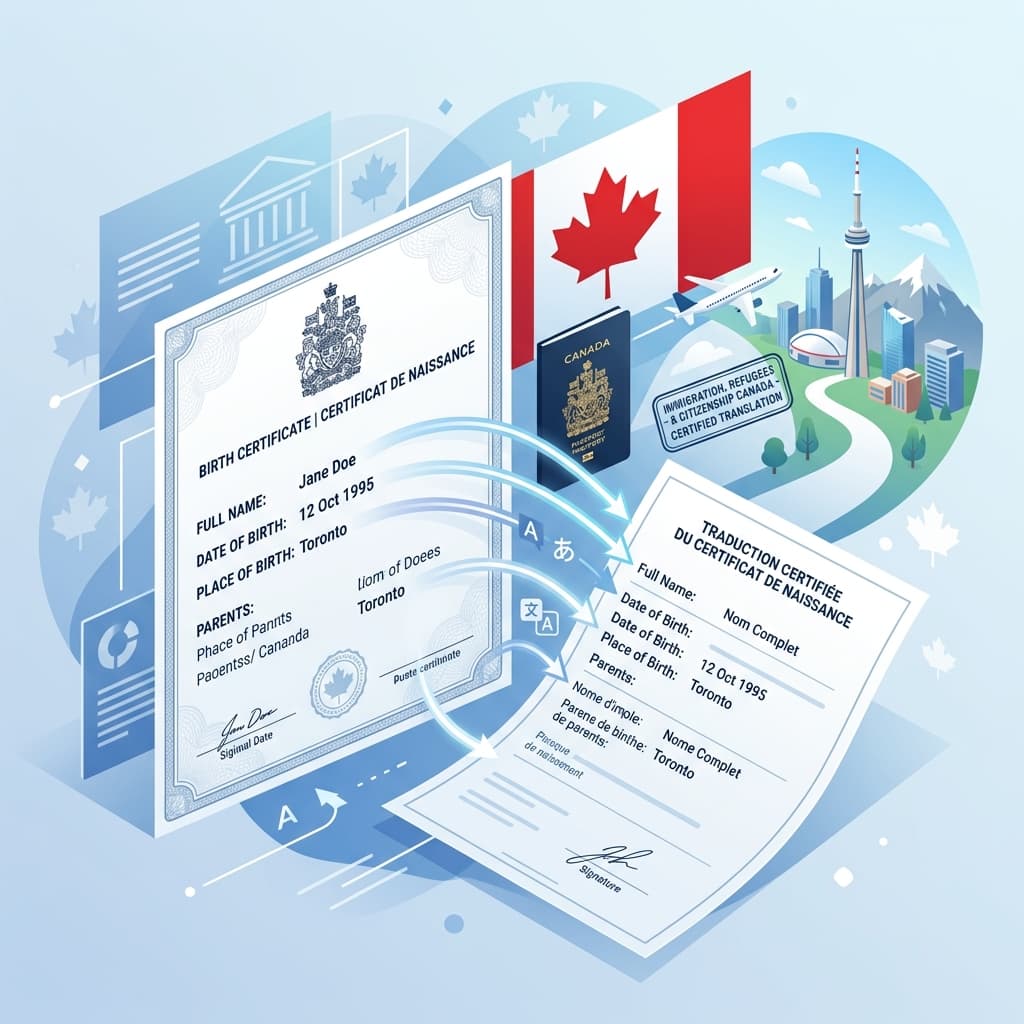
- The language pair (e.g., "translated from Mandarin to English")
At A2Z Language Hub, every certified translation we deliver includes a compliant certification statement that meets IRCC standards.
Documents Commonly Required by IRCC
The specific documents you need translated depend on your application type, but here are the most frequently requested:
- Identity documents: Birth certificates, passports, national ID cards
- Civil status documents: Marriage certificates, divorce decrees, death certificates
- Education documents: Diplomas, degrees, academic transcripts
- Employment documents: Reference letters, employment contracts, pay stubs
- Police clearance certificates from your country of origin
- Financial documents: Bank statements, tax returns, property records
- Medical documents (when applicable)
If any of these documents are in a language other than English or French, you must submit the original (or a certified copy) along with the certified translation.
Accepted Translation Formats
IRCC accepts translations in digital (PDF) and hard copy formats, depending on the application stream. For online applications through the IRCC portal, you will typically upload a PDF that includes:
- A scan of the original document
- The certified translation
- The translator's certification statement
All three elements should ideally be combined into a single PDF for each document. A2Z Language Hub delivers translations in this ready-to-upload format so you do not need to do additional preparation.
Common Mistakes That Lead to Rejection
Even small errors can result in your application being returned. Here are the most frequent mistakes we see:
Using Google Translate or Machine Translation
IRCC does not accept machine-generated translations. Every translation must be completed by a human translator with a signed certification statement. Using Google Translate or any AI translation tool will result in rejection.
Having a Family Member Translate
Your spouse, parent, sibling, or child cannot translate your documents for an IRCC application, even if they are fluent in both languages. The translator must be an independent third party.
Missing or Incomplete Certification Statements
A translation without the required declaration, or with missing information such as the translator's contact details, will not be accepted. Always verify that your provider includes a complete certification statement.
Translating Only Part of the Document
IRCC requires complete translations. If your birth certificate has text on the front and back, both sides must be translated. Partial translations will be returned.
Poor Formatting
Translations should mirror the layout of the original document as closely as possible. Disorganized or poorly formatted translations can raise concerns about accuracy.
How Long Does IRCC Translation Take?
Standard turnaround for most personal documents is 2 to 3 business days. Multi-page documents like academic transcripts or legal contracts may take 3 to 5 business days. Rush and same-day options are available at A2Z Language Hub for urgent deadlines. See our pricing guide for details on costs.
Tips for a Smooth IRCC Translation Process
- Start early. Do not wait until the last week before your application deadline to arrange translations.
- Submit clear, complete scans. Ensure every page of the original document is legible and fully visible.
- Double-check names and dates. Verify that all personal information matches across your documents before submitting.
- Work with a trusted provider. Choose a translation service whose work is consistently accepted by IRCC. At A2Z Language Hub, our translations have a proven track record with IRCC, WES, IQAS, and provincial immigration programs.
Get Your IRCC-Ready Translations Today
Do not let translation issues hold up your immigration application. A2Z Language Hub provides fast, accurate, and fully compliant certified translations for all IRCC application types.
Ready to get started? Request your free quote and receive your IRCC-compliant translations in as little as 24 hours. Browse our full range of translation services to learn more.
Primary sources
The requirements described on this page come from the official sources below. Rules change — check the source itself before you file.
- Immigration, Refugees and Citizenship Canada. What language should my supporting documents be in?. checked .
- Immigration, Refugees and Citizenship Canada. What is an affidavit for a translation?. checked .
- Immigration, Refugees and Citizenship Canada. Apply for permanent residence through Express Entry. checked .